Consider this: 90% of supply chain disruptions stem from failures in coordination, not technology. That’s the stark reality underpinning the current frenzy around agentic AI. The promise is seductive: autonomous software agents monitoring conditions, evaluating options, and — crucially — communicating with each other to drive smarter, faster decisions across planning, procurement, logistics, inventory, and customer service. But here’s the critical juncture, the point where the shiny promise hits the hard pavement of operational reality: agent communication alone is not the finish line. Coordinated execution is the prize.
Look, supply chains are, by their very nature, already complex multi-agent systems. Think about it. Procurement chasing unit costs, planning buffering against stockouts, transportation optimizing for carrier rates, and customer service promising delivery dates. Each of these functions, historically represented by human teams armed with siloed software and a cascade of emails, phone calls, and spreadsheets, operates with partial information and competing local objectives. This inherent fragmentation leads to the very disruptions we’re trying to avoid – conflicting decisions that ripple through the entire chain, causing latency and, frankly, chaos.
Is Agentic AI Just a Fancy Chatbot for Your Warehouse?
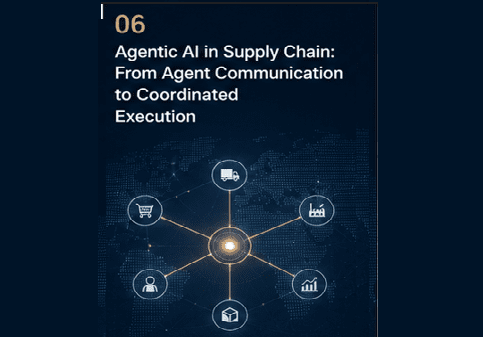
This is where the narrative often gets muddled. The real power of agentic AI doesn’t lie in creating a digital water cooler for software bots. It’s about embedding specialized AI agents into specific domains – a transportation agent flagging a delayed inbound shipment, an inventory agent assessing stockout risk, a procurement agent scouting alternative suppliers, a customer service agent flagging at-risk orders. The magic happens when these agents don’t just spit out isolated alerts. Instead, they must coordinate.
When that inbound shipment misses its appointment, the transportation agent flags it. The inventory agent checks for stockout risk. Procurement investigates alternative sourcing. Customer service pinpoints affected orders. The system, ideally, then orchestrates a governed response: assessing the service risk, evaluating mitigation strategies, routing for approval if necessary, and updating workflows once action is authorized. This isn’t a dashboard notification; it’s a proactive, coordinated response. It’s execution.
Why Shared Context is the Unsung Hero
And herein lies the essential, often overlooked, prerequisite for any of this to work: shared context. Without it, agentic AI doesn’t solve fragmentation; it automates it. Imagine one agent recommending expedited freight, another suggesting inventory reallocation, and a third pushing to change a promise date – all without a common understanding of business rules, master data, customer priorities, or operational constraints. The result? Recommendations that not only conflict but actively undermine each other.
This is why concepts like model context, knowledge graphs, and retrieval-based architectures aren’t just technical jargon; they’re the foundational glue for coordinated AI. Agents need more than just data feeds; they require a unified representation of the operating environment. It’s about building a shared understanding of the world the supply chain operates within.
Governance: The Brake Pedal You Can’t Ignore
The more agents are empowered to coordinate action, the more critical governance becomes. Who has the authority to recommend? Who can execute? What happens when agents fundamentally disagree? When does a human hand-off become necessary? How are decisions logged, and how are downstream impacts meticulously tracked? This isn’t a minor detail; it’s the bedrock of trust and accountability.
Leaders should be wary of claims of unfettered autonomy. In the near term, the practical, and frankly sensible, model is bounded, governed, human-supervised autonomy. Agents can certainly monitor, recommend, and even execute within clearly defined thresholds. But for decisions with significant impact – the kind that can move the needle on profit or customer satisfaction – human oversight isn’t a bug; it’s a feature. It’s how you build resilience and ensure that technology serves, rather than dictates, your supply chain’s destiny.
The appeal of agentic AI is that it could help coordinate these interdependent decisions faster than traditional workflows allow. But there is an important caution. Agent communication by itself is not the goal. Coordinated execution is the goal.
This distinction, subtle yet profound, will separate the transformative applications of agentic AI from the expensive, overly-hyped experiments. The focus must remain on driving integrated, intelligent action, not just on enabling a digital conversation.
🧬 Related Insights
- Read more: USPS’s 8% Parcel Rate Spike: Temporary Band-Aid or Supply Chain Signal?
- Read more: Magaya Momentum: AI and Volatility Reshape Freight Forwarding
Frequently Asked Questions
What is agentic AI in supply chain? Agentic AI in supply chain refers to autonomous software agents capable of monitoring conditions, evaluating options, communicating with other agents, and initiating workflows to improve coordinated decision-making across various supply chain functions.
Will agentic AI replace supply chain planners? Agentic AI is more likely to augment the role of supply chain planners by automating routine tasks and providing data-driven recommendations, allowing planners to focus on higher-level strategy and exception management rather than manual coordination.
What is the main challenge for agentic AI in supply chains? The primary challenge is achieving true coordinated execution, which requires agents to share context effectively, operate under strong governance frameworks, and integrate smoothly with existing systems, rather than just communicating with each other.