Forget the chatbot hype. For AI to truly transform supply chains, it needs more than just data. It demands an architectural shift focused on actionable outcomes. This isn’t about generating pretty reports anymore; it’s about making the gears of global commerce turn faster, smarter, and more reliably. The market’s fascination with AI’s predictive prowess is palpable, yet many organizations are still wrestling with the foundational elements that allow these sophisticated models to do anything more than sit on a shelf, gathering digital dust.
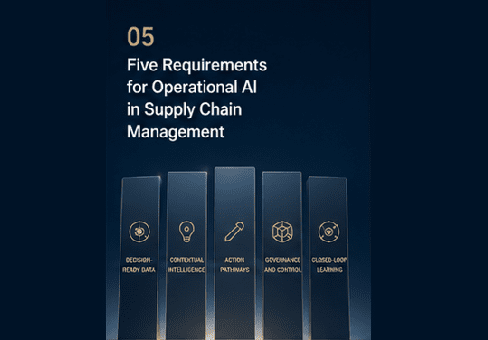
The pivot from merely answering questions to actively operating within the supply chain — that’s the real frontier. It’s a transition that necessitates a complete overhaul, moving past isolated tools to a connected operating system for logistics. This evolution requires a disciplined approach to five core requirements: decision-ready data, contextual intelligence, action pathways, strong governance, and closed-loop learning.
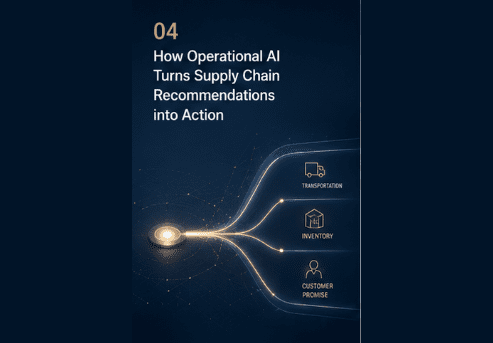
What does this look like in practice? Think of a shipment delay. A generic AI might flag it. An operational AI, however, understands why it matters: Is the customer strategic? Is the product critical? Is there buffer stock elsewhere? This isn’t just about identifying a problem; it’s about understanding its cascading implications across the entire value chain.
Data: The Unsung Hero of Operational AI
The first, and often the most glaring, hurdle is decision-ready data. This sounds almost insultingly obvious, doesn’t it? Yet, it’s the bedrock upon which all sophisticated AI sits, and it’s precisely where many supply chains crumble. We’re talking about a fragmented landscape where order data lives in one silo, shipment tracking in another, inventory management a third, and supplier records still another. AI can’t reliably improve decisions if the data it’s fed is incomplete, outdated, a tangled mess of duplicates, or just plain inconsistent.
Decision-ready data doesn’t equate to a mythical state of perfect information. It means data that’s sufficiently clean, current, harmonized, and interconnected to genuinely support operational decisions. A transportation AI needs accurate carrier details, lane specifics, cost structures, transit times, and real-time capacity. Planning AI requires precise demand figures, inventory levels, supply chain inputs, and critical constraint parameters. Procurement AI hinges on reliable supplier performance metrics, contract terms, risk assessments, and financial health indicators. The issue isn’t a lack of data; most companies are drowning in it. The true challenge is structuring it so AI can actually trust and utilize it for actionable insights.
Context is King (Even for Machines)
Next up: contextual intelligence. Generic AI can summarize; operational AI must grasp why the summarized information is significant. In the supply chain realm, context is a rich mix of customer commitments, supplier histories, seasonal fluctuations, contractual obligations, penalty clauses, facility limitations, product substitutability, inventory policies, lead-time variability, regulatory mandates, and historical patterns of exceptions. A delayed shipment, for instance, carries vastly different weight depending on whether the recipient is a high-value, strategic client or part of a routine replenishment cycle. Without this nuanced understanding, AI risks offering plausible but ultimately superficial recommendations.
This is where architectural advancements like Retrieval Augmented Generation (RAG), Graph RAG, knowledge graphs, and dedicated model context layers become indispensable. They equip AI with the ability to not only retrieve relevant documents but also to deeply understand interrelationships and preserve critical operational history, moving it from a reactive observer to a proactive participant.
From Insight to Action: The Crucial Pathway
Then there’s the vital requirement of action pathways. An AI system that brilliantly identifies a problem but lacks the ability to connect to existing workflows remains largely advisory. It’s a helpful assistant, certainly, but it doesn’t fundamentally transform operations. Operational AI must possess clear pathways into the systems where the actual work happens—think Transportation Management Systems (TMS), Warehouse Management Systems (WMS), Enterprise Resource Planning (ERP), Order Management Systems (OMS), procurement platforms, supplier portals, customer service tools, and control towers.
If the AI suggests rerouting a shipment, it must comprehend the tendering process. If it recommends reallocating inventory, it needs to understand the implications for orders and warehouse operations. If it proposes a supplier change, it must grasp procurement rules and requisite approval thresholds. This distinction is precisely where many AI demonstrations diverge from real-world deployments. Generating a recommendation is one hurdle; embedding that recommendation smoothly into the operational process is an entirely different, and far more complex, undertaking.
Governance: The Guardrails for Scalability
Supply chain decisions carry significant financial, operational, customer-facing, and compliance ramifications. As AI becomes more deeply integrated into these critical decisions, establishing clear guardrails through governance and control is paramount. Questions arise: Who holds the authority to approve AI-recommended actions? Which decisions are candidates for full automation? At what point do thresholds necessitate escalation? How are decisions meticulously logged for audit purposes? How are model outputs rigorously audited? And, critically, how is sensitive data protected?
These aren’t peripheral concerns; they are central to AI adoption. Planners and operators won’t embrace AI if they can’t understand its decision-making logic. Executives won’t commit to scaling AI solutions if the associated risks can’t be effectively managed. Legal and compliance teams simply won’t sign off on autonomous workflows without a clear line of sight to auditability. Governance, therefore, isn’t a constraint on AI’s potential; it’s the very mechanism that enables its responsible and scalable deployment.
Learning and Adapting: The Feedback Loop
Finally, the fifth cornerstone is closed-loop learning. AI must evolve beyond simply recommending actions; it needs to learn from the outcomes of those actions. This means establishing mechanisms to feed the results of AI-driven decisions back into the models, allowing them to refine their predictions and recommendations over time. Without this continuous feedback loop, AI systems risk becoming stagnant, failing to adapt to dynamic market conditions or emerging operational patterns.
The ultimate success of AI in the supply chain won’t be measured by the elegance of its algorithms or the volume of its outputs. It will be determined by its capacity to integrate into the core operational fabric, driving tangible improvements in efficiency, resilience, and responsiveness. The organizations that focus on these five requirements—decision-ready data, contextual intelligence, action pathways, governance, and closed-loop learning—will be the ones that truly unlock AI’s potential to move from advisory tool to an indispensable operational intelligence layer.
The AI Supply Chain Imperative
For leaders navigating this complex terrain, the message is clear: AI isn’t a magic wand. It’s an architecture. It requires a disciplined, holistic approach that prioritizes data integrity, contextual understanding, actionable integration, strong oversight, and continuous learning. Those who master these elements will be positioned to redefine operational excellence in the modern supply chain.
🧬 Related Insights
- Read more: Trump Blasts Iran’s Strait of Hormuz Tolls as Tankers Rot and Prices Spike
- Read more: [AI] Delivery Fleets Find Hidden Capacity. Here’s How.
Frequently Asked Questions
Will AI replace supply chain jobs? AI is more likely to augment human roles, automating repetitive tasks and providing insights that empower professionals to focus on more strategic decision-making. Some roles may shift, but outright replacement across the board is unlikely in the near term.
How do I get started with operational AI in my supply chain? Begin by assessing your data quality and integration across disparate systems. Identify a specific, high-impact operational challenge that AI could address, and focus on building the foundational requirements—data, context, and action pathways—for that use case.
What is RAG in the context of supply chain AI? RAG, or Retrieval Augmented Generation, is an AI technique that enhances language models by allowing them to access and retrieve information from external knowledge bases (like your supply chain data) before generating a response. This helps ensure AI recommendations are grounded in specific, relevant, and up-to-date data.