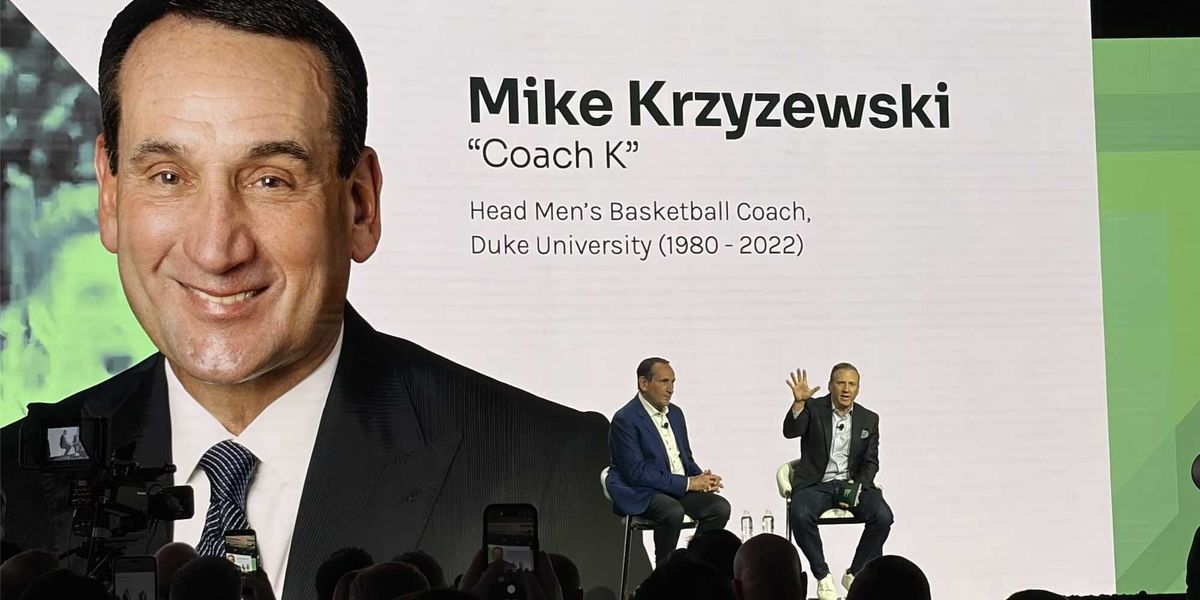
Did you ever stop to think that the same man who stalked the sidelines at Cameron Indoor Stadium, orchestrating championships with a furious intensity, might also hold the keys to a more efficient warehouse or a resilient global network? Mike Krzyzewski, Coach K himself, hobbled slightly at Manhattan Associates’ annual user conference in Las Vegas, but his message? As sharp as ever. He’s 79, sports more artificial joints than a robotics convention, but the competitive fire and the hard-won wisdom remain intact.
It’s easy to dismiss a sports figure’s foray into business as mere motivational fluff. But Krzyzewski’s narrative isn’t about rah-rah slogans; it’s steeped in the kind of disciplined, values-driven structure that underpins any high-performing operation, be it a basketball team or a complex supply chain. He didn’t just learn to win games; he learned to build organizations. And his teachers? None other than the stern disciplinarians of West Point, including the famously demanding Bob Knight. That’s where the foundational tenets—honor, integrity, and a blunt, no-excuses approach—were forged. “You don’t lie, cheat, or steal. Or tolerate anyone who does,” he stated, a mantra that ought to be etched on the loading dock doors of every logistics hub.
What’s fascinating here is how Krzyzewski frames his approach, particularly his emphasis on preparation over just the outcome. He cites Coach Knight’s adage: “The will to prepare to win is more important than the will to win.” Think about that in a supply chain context. It’s not just about hitting delivery targets; it’s about the meticulous planning, the risk mitigation, the forecasting accuracy, the supplier vetting that makes hitting those targets possible, and repeatable. His teams, he explained, were prepared to be worthy of winning. The competition had to beat them, not just win because they were unprepared.
Beyond the discipline, though, lies a surprising degree of adaptability. Krzyzewski spoke candidly about having to continually adjust his communication style to connect with successive generations of young players who seemed perpetually the same age while he aged. This isn’t just about chasing trends; it’s about understanding evolving human dynamics and communication channels. In the supply chain, this translates to understanding new workforce demographics, adapting to different supplier cultures, and embracing new technological platforms that might seem alien to established processes. He had to change how he communicated “maybe 15 or 20 times.” That’s a level of iterative evolution many businesses shy away from.
The Seven Pillars of Krzyzewski’s Playbook
But the bedrock of his philosophy, and perhaps the most transferable element to the often-gritty reality of supply chain management, are the seven values he learned from his mother, Emily. A cleaner by trade, with an eighth-grade education, she instilled a set of principles that are remarkably strong and remarkably simple.
- Integrity: Do the right thing, and hold each other accountable. This is the ethical spine of any operation.
- Respect: Everyone is important. Know their first names, say please and thank you. In an industry often characterized by transactional relationships, this human element is vital for building trust and loyalty with partners, employees, and even customers.
- Courage: Say or do what needs to be said or done, in that moment. This speaks to decision-making under pressure, whether it’s addressing a critical inventory shortage or confronting a performance issue.
- Selfless Service: Focus on the team and others before yourself. The ultimate antidote to internal silos and finger-pointing.
- Loyalty: Stand by your team and your people through thick and thin. Essential for weathering the inevitable storms that batter supply chains.
- Duty: Come to work, and believe in the dignity of work. A profound reminder of the value and importance of every role, from the warehouse floor to the executive suite.
- Trust: Believe in your teammates’ intentions and abilities. The linchpin of collaboration and efficient execution.
Why Does This Matter for Supply Chains?
Look, the supply chain is a complex ecosystem. It’s not just about moving boxes; it’s about managing relationships, anticipating disruptions, and making high-stakes decisions with imperfect information. Krzyzewski’s lessons, born from the pressure cooker of elite sports, offer a compelling framework. His emphasis on preparation, adaptability, and an unwavering moral compass resonates deeply with the challenges of building resilient and ethical supply chains. While he might not be talking about freight optimization algorithms or warehouse robotics directly, the principles of leadership, accountability, and trust he espoused are the human infrastructure that makes any system, technological or otherwise, truly functional.
“The will to prepare to win is more important than the will to win.” This single quote, from his mentor Bob Knight, encapsulates a philosophy that’s as relevant to a supply chain manager as it is to a basketball coach. It’s about the process, the dedication to the details, and building a foundation so solid that success becomes not just a possibility, but an inevitability.
It’s a reminder that for all the advancements in technology and data analytics, the fundamental elements of successful operations—people, principles, and preparation—remain constant. Coach K, even in his seventh decade and with a rebuilt chassis, is still coaching. And for those in the business of moving goods across the planet, that’s a valuable game to watch.