The faint hum of servers in a massive data center, a quiet hum that underpins the relentless efficiency of Amazon’s global logistics. Now, that hum is being amplified, broadcasted beyond the company’s own storefronts.
Amazon Supply Chain Services, a name that sounds less like a new venture and more like a definitive statement of intent, has officially unfurled. It’s a bold move, a calculated unbundling of the very infrastructure that powers its retail juggernaut. This isn’t about selling more books or Alexa devices; it’s about commoditizing the complex ballet of getting goods from point A to point Z, and doing it for everyone.
Think of it as Amazon Web Services, but for physical stuff. For years, the company has meticulously built and refined a logistics empire, a labyrinth of planes, ships, trucks, and warehouses, all humming in concert to deliver packages with almost unnerving speed and precision. Now, the gates are open. Businesses, from burgeoning startups to established giants like Procter & Gamble, 3M, and American Eagle Outfitters, can tap into this behemoth. It’s a unified network, promising to replace the Frankenstein of fragmented contracts and disparate providers with a single pane of glass. A lofty goal, no doubt.
The ‘How’ of Amazon’s Logistics Utility
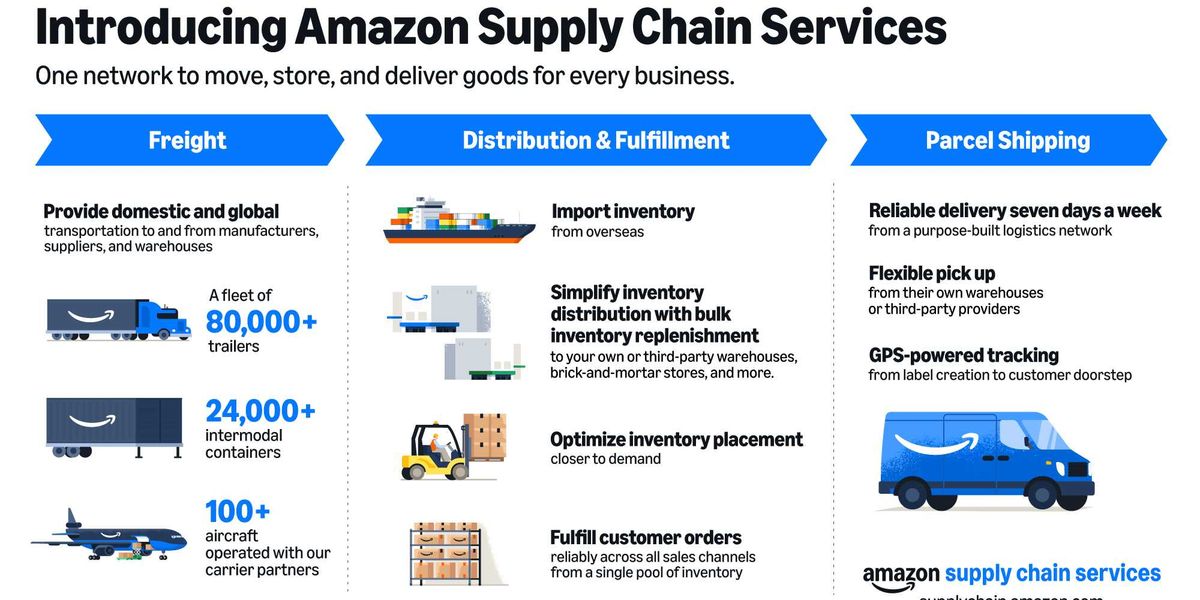
What does this actually entail? On the surface, it’s a tripartite offering: freight, distribution, and parcel shipping. But peel back the layers, and you see a deeply integrated architecture designed to absorb and manage complexity. Freight encompasses multimodal transportation – air, ocean, rail, ground – complete with customs support and the all-important end-to-end visibility that so many companies still struggle to achieve. It’s the plumbing, the arteries of global movement.
Then there’s distribution and fulfillment. This is the centralized brain, a system for managing inventory across every conceivable sales channel – wholesale, direct-to-consumer, social media, even brick-and-mortar. The promise is a unified inventory pool, a single source of truth that can dynamically push products where they need to be, eliminating the costly guesswork and the dreaded stockouts. It’s about treating inventory not as a static asset, but as a fluid resource.
Finally, parcel shipping. Amazon’s bread and butter. An expansive ground network, seven days a week, with delivery speeds that have set industry benchmarks. This is the sharp end, the final, critical link to the consumer, now available for anyone who can afford the price of admission.
Why This Matters: A Shift in the Supply Chain Paradigm
This move is far more than just a new revenue stream for Amazon. It’s an architectural shift. By decoupling these services from its retail arm, Amazon is strategically positioning its logistics network as a utility. It’s a play for ubiquity, a bid to become the foundational layer upon which the next generation of e-commerce and retail operations will be built. The implications are enormous. Companies that have long been hamstrung by their own logistical limitations can now outsource that burden to a proven entity. It’s the commoditization of physical fulfillment, mirroring the commoditization of computing power with AWS.
This also forces a reckoning for traditional third-party logistics (3PL) providers. Can they compete with an entity that operates at Amazon’s scale, with its proprietary technology and unparalleled data insights? The ARC Advisory Group white papers, tucked away in the periphery of this announcement, hint at the broader AI-driven evolution of supply chain execution. They speak of AI moving from isolated copilots to coordinated operational decision systems. Amazon’s move fits squarely within this broader trend, leveraging its immense data and AI capabilities to offer a more intelligent, integrated service.
But let’s be clear: this isn’t a philanthropic endeavor. It’s a business strategy executed with Amazon’s characteristic ruthlessness. They’re not just offering a service; they’re offering the service, the one that can potentially dictate terms and shape future market dynamics. The scale is staggering; the network currently handles approximately 13 billion items annually. That’s not just volume; that’s data, that’s optimization potential, that’s use.
“The goal is to address the complexity of supply chain management by replacing fragmented, multi-provider contracts with a single, end-to-end interface.”
This sentence, buried in Amazon’s announcement, is the crux of it all. Simplicity. A single interface for a world of logistical chaos. It’s the siren song to businesses drowning in complexity. Whether it truly delivers on that promise, or merely shifts the locus of control, remains to be seen. But one thing is clear: Amazon isn’t just delivering packages anymore. It’s aiming to deliver the entire supply chain.
This is a strategic gambit, leveraging an existing, massive asset to create a new, dominant market position. It’s the kind of move that fundamentally redraws the competitive landscape, forcing rivals to rethink their own value propositions and architectural strategies. The era of the logistics utility has begun.