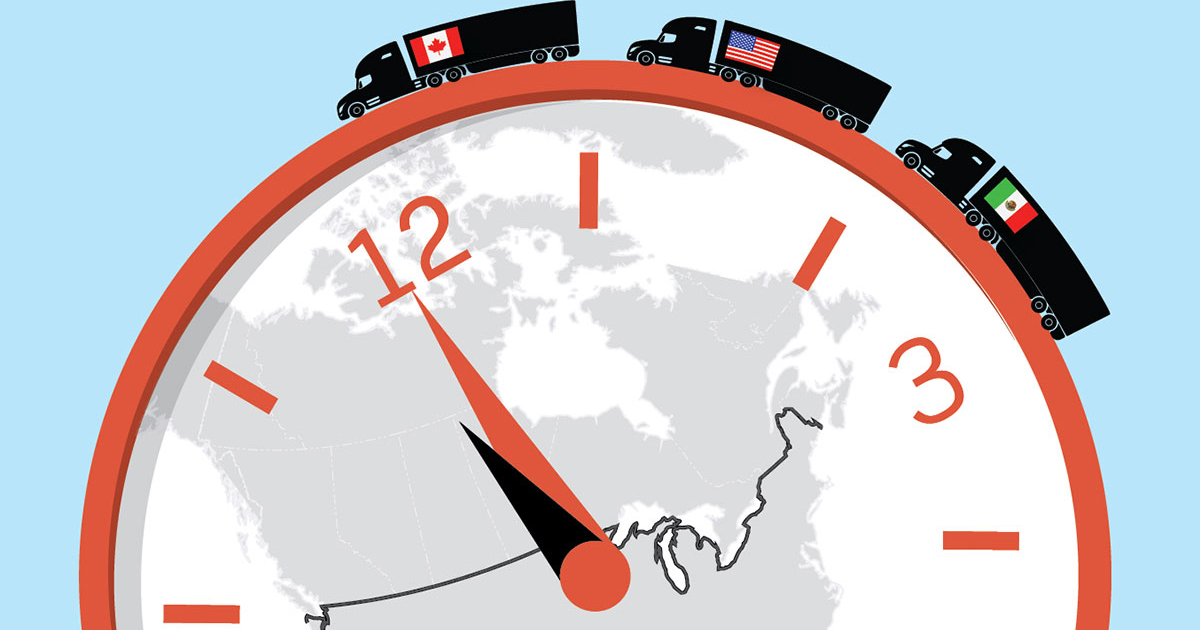
Review deadline looms.
The United States-Mexico-Canada Agreement, or USMCA for those who like acronyms that sound like medical conditions, is at a crossroads. July 1. That’s the date. The three North American nations must decide if this trade pact, which replaced NAFTA and supposedly calmed the freight waters, gets a 16-year extension or tumbles into a morass of annual reviews. And the people who haul the goods? They’re sweating. Not about border closures, mind you. It’s the not knowing that’s the real killer.
Think about it. You’re a trucking company. You need to buy trucks. You need to hire drivers. You need to plan routes. All of this requires a degree of certainty about the future of trade. USMCA, for all its geopolitical theater, was supposed to provide that. It helped boost manufacturing, sure. It made Mexico a powerhouse. It created one of the biggest trucking markets on the planet. Now? Crickets.
Carriers say prolonged uncertainty, not border disruption, risks chilling investment and capacity planning in an already fragile freight market, despite strong trade growth after USMCA began in 2020.
That’s the crux of it. It’s not the disruption itself that’s the immediate fear. It’s the slow bleed of indecision. Companies like R+L Carriers, Southeastern Freight Lines, and A. Duie Pyle, all big players, have been expanding their cross-border reach. But TFI International, a Canadian giant, is holding off on its full-year guidance. Why? Because the trade picture is a murky mess.
Alain Bédard, TFI’s CEO, put it bluntly: “It’s too unstable right now until we have that.” He’s seen this movie before. Trump’s tariffs — remember those? — trashed his flatbed operations. This feels like déjà vu, only with more corporate jargon and less direct yelling.
Will Annual Reviews Kill Trade?
This July 1 date isn’t some magic wand that instantly rewrites the agreement. It’s a trigger. Either the pact gets a long leash, or it enters a yearly gauntlet. And that annual review? That sounds like a bureaucratic nightmare. Imagine every year, for the rest of time, having to justify the fundamental flow of goods between three of the world’s largest economies. It’s a recipe for perpetual anxiety, a constant low-grade fever of doubt.
U.S. imports are at record highs. Mexico and Canada are our top dogs. Yet, here we are, debating whether to make the system more stable or less. It’s like being offered a sturdy bridge or a rickety rope swing over a canyon. And guess which one the powers-that-be seem to be leaning towards?
The initial talks, a discreet rumble between the U.S. and Mexico starting the week of May 25, are just that. Preliminary. Canada is still figuring out its global swagger after some… interesting pronouncements about its territorial status. Don’t expect swift resolutions.
Is This Just More Political Theater?
Frankly, it feels like it. The USMCA was born out of a desire to renegotiate, to assert dominance, to reshore jobs. It succeeded, in part, by being a known quantity. Now, the very act of reviewing it threatens to unravel the predictability that made it work. The carriers, the ones on the ground moving the freight, aren’t asking for the moon. They’re asking for a clear path. What they’re getting is a fog machine.
The real danger isn’t a sudden trade war. It’s the slow erosion of confidence. It’s the deferred investments, the hesitant hiring, the capacity that never materializes because no one wants to bet on a future that shifts annually. This isn’t just about tariffs and trade balances; it’s about the operational heartbeat of North American logistics. And right now, that heartbeat is getting erratic.
This whole situation smacks of the same old playbook: create a crisis, then negotiate under duress. It worked before, apparently. So why change it? Except this time, the supply chain, already bruised and battered, might not have the resilience for another round of manufactured instability.
🧬 Related Insights
- Read more: Trucking Crunch Pushes Shippers to Intermodal Lifeline
- Read more: $774M for US Ports: More Than Just PR?
Frequently Asked Questions
What is the USMCA mandatory review? The USMCA agreement includes a provision for a mandatory review five years after its implementation. This review cycle culminates on July 1, where the member countries must decide whether to extend the agreement for another 16 years or move to an annual review process.
How does USMCA uncertainty affect trucking companies? Uncertainty about the future of the USMCA can lead trucking companies to delay or scale back investments in new equipment, fleet expansion, and network development. This can impact capacity planning and create volatility in an already challenging freight market.
When will a decision on USMCA’s future be made? While the July 1 date is a critical milestone for deciding between a 16-year extension or annual reviews, actual negotiations and final decisions may extend beyond this deadline.