Party lines harden.
It’s not just about policy anymore; it’s about perception. The latest Axios Harris Poll 100 data paints a stark picture: the Republican party is increasingly embracing AI, while Democrats are becoming notably more skeptical of the technology and the industry churning it out. This isn’t a subtle drift; it’s a significant realignment in just two years, accelerated by seismic shifts in AI advancement and, no doubt, the changing political winds following the White House transition.
OpenAI’s Shifting Sands
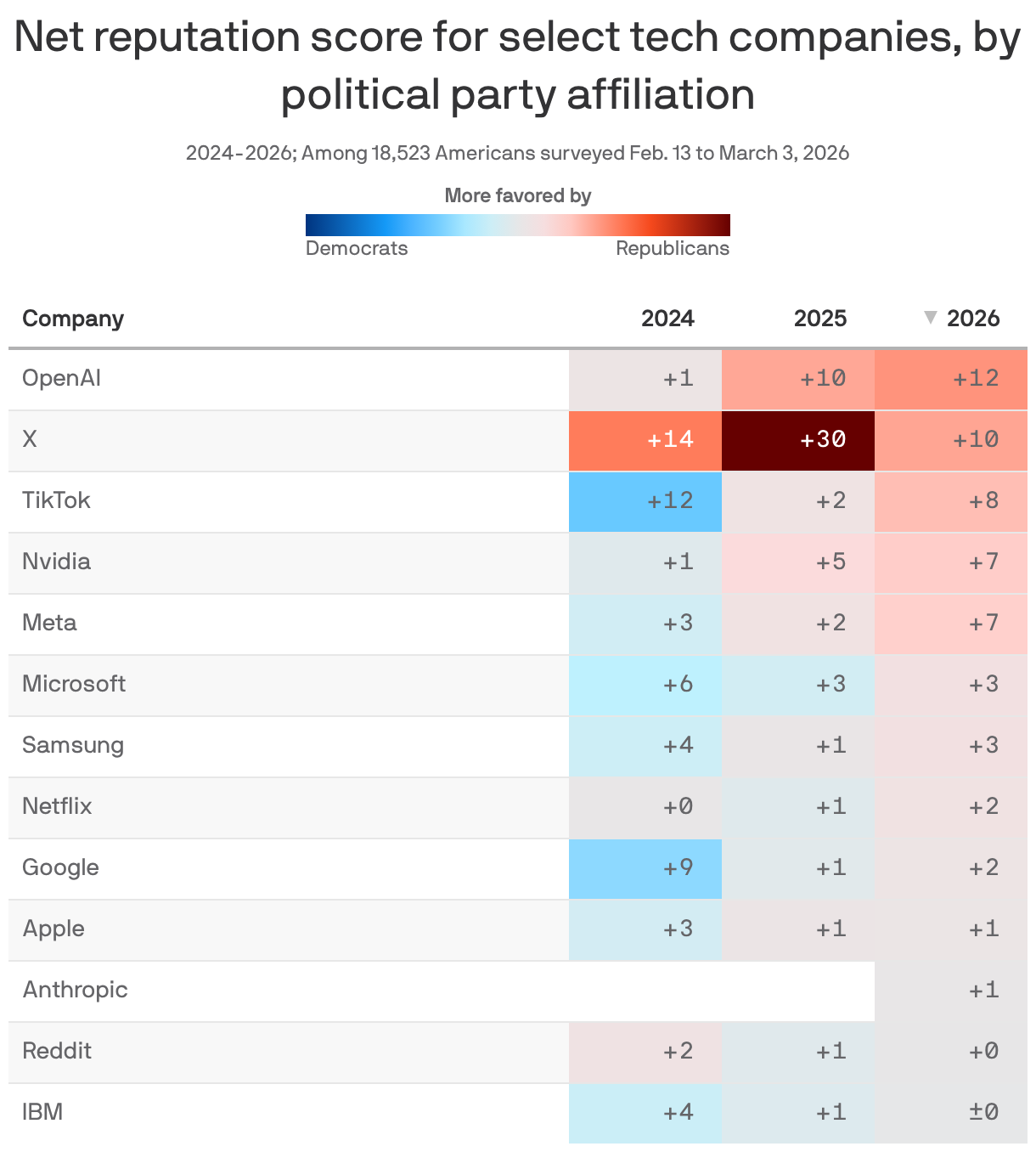
Sam Altman’s OpenAI, a bellwether for the industry, perfectly illustrates this divergence. In 2024, the partisan gap in its reputational score was a mere 1 point. Today? That chasm has ballooned to a stark 12 points. And it’s not just OpenAI. Companies like TikTok, Nvidia, Meta, and X—all deeply intertwined with AI or AI-driven operations—are exhibiting similarly widening partisan fissures. This suggests that the AI narrative is no longer a neutral technological discussion; it’s becoming a distinctly partisan battleground.
Is This Widening Gap a Red Flag?
The data here offers a sharp insight: AI companies with narrower partisan gaps tend to score higher in overall reputation. It’s a counterintuitive point, perhaps, but it speaks volumes. While the headline might be about GOP embrace, the underlying market dynamic is that broad-based trust is still the gold standard for solid brand equity. Take Anthropic, for instance. Dario Amodei’s company lands at No. 15 overall, a respectable showing, with a minuscule 1-point partisan gap. Compare that to OpenAI at No. 68. This disparity, according to the poll, isn’t accidental. Anthropic’s stance against lifting safeguards that prevent mass domestic surveillance or autonomous weapons development—actions that previously “infuriated” the Trump administration—seems to have insulated it from the partisan pull affecting others.
The Numbers Don’t Lie
Let’s look at the raw figures. A strong 44% of Republicans report a more positive view of AI over the past year, a sentiment shared by only 35% of Democrats. Conversely, concerns about AI’s impact on careers and wages are more pronounced among Democrats, with 40% anticipating significant harm, compared to 32% of Republicans. This divergence isn’t just about optimism versus pessimism; it’s about how different political camps are framing the societal implications of this technology. The anxieties voiced by Democrats often echo the very concerns about job disruption that AI executives themselves have highlighted, fueling a broader apprehension about data centers, energy costs, misuse, and potential government overreach.
The Trump Effect and Gen Z’s AI Anxiety
It’s fascinating, isn’t it, how political figures can shift the perception of complex technologies? President Trump’s embrace of AI appears to be a significant factor in reassuring some within his party. This is a powerful proof to the personal influence of political leaders in shaping public opinion on emerging tech. Meanwhile, the trend also reflects a generational divide, particularly among younger voters who tend to lean left. These younger Americans, particularly Gen Z, express profound anxieties that AI is poised to gobble up entry-level jobs. The poll found 42% of Gen Z respondents believing AI will negatively impact their job prospects, a sentiment higher than among millennials, Gen X, and Baby Boomers. Millennials, having navigated earlier tech shifts and generally more established in their careers, exhibit a relative confidence, perhaps reflecting their greater adaptability and existing tech fluency.
What the Pollsters Are Saying
John Gerzema, CEO of The Harris Poll, offers a sharp-edged observation: “The cultural fault lines are quickly being drawn on whether AI is a benefactor or a ‘broligarchy.’” He further notes a significant shift in how AI firms are perceived. “In our Axios Harris poll, for a decade we’ve seen Big Tech more left, more progressive. But if you look at this basket of AI firms, with the exception of Anthropic, they’ve all shifted to the right as their innovation and market dominance appears unrivaled in the years to come.” This isn’t just about corporate reputation management; it signals a potential realignment of market forces and consumer allegiance, moving away from the more progressive branding historically associated with Big Tech. It’s a commercial inflection point, I’d argue, driven by perceived innovation rather than social alignment.
AI: The New Political Battleground
The ultimate takeaway is that AI is no longer a niche technological topic for industry insiders or academics. It has officially entered the political arena, becoming a significant factor on par with jobs, the economy, immigration, and climate change. As we head towards elections, the stance voters take on AI could very well influence their choices. For businesses in the AI space, navigating this increasingly polarized landscape won’t just be about product development; it will require a sophisticated understanding of political optics and a keen awareness of how partisan narratives shape public trust and market adoption. Ignoring this dynamic would be, frankly, a dereliction of duty for any serious player in the AI ecosystem.
🧬 Related Insights
- Read more: Container Spot Rates Surge as Peak Season Arrives Early
- Read more: CBP’s $85B Refund Portal: Who Actually Gets Paid?
Frequently Asked Questions
What does the Axios Harris Poll 100 measure?
The Axios Harris Poll 100 measures the reputation of the 100 most visible companies in America across various industries, assessing public perception based on factors like trust, trustworthiness, and overall brand favorability.
Why is there a partisan gap in AI trust?
The partisan gap in AI trust appears to stem from differing perceptions of AI’s societal impact, economic implications (especially job security), potential for misuse, and the influence of political rhetoric and endorsements from party leaders.
How does Anthropic’s reputation differ from OpenAI’s?
Anthropic generally enjoys a stronger overall reputation and a much narrower partisan gap compared to OpenAI. This is partly attributed to Anthropic’s ethical stances on AI development and its refusal to compromise safeguards, which contrasts with OpenAI’s broader industry positioning and the wider partisan divisions it faces.