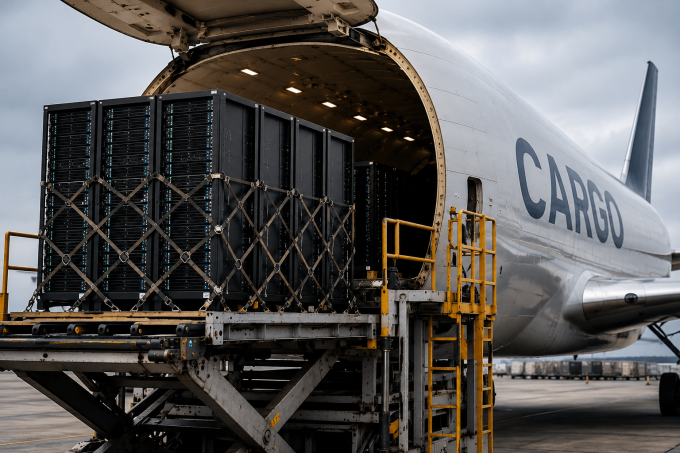
And then, BAM! You’re knee-deep in a silicon sandstorm. That’s how it feels when you look at air cargo today. One moment, you’re seeing these mind-boggling growth numbers, this rocket ship fueled by the insatiable appetite for all things Artificial Intelligence. We’re talking server racks, GPUs, the whole glittering, high-tech ecosystem—all demanding premium, fast-track transport via air. It’s a gold rush, plain and simple, and cargo airlines are scrambling to cash in.
But here’s the twist, the jarring plot development that makes you spill your coffee: the very foundation of this AI boom—the advanced semiconductors—is running on fumes. Literally. Helium. And right now, a massive chunk of that precious gas supply is being choked off by geopolitical turmoil in the Middle East. It’s like trying to build a skyscraper and discovering the concrete supply is locked down by an international incident.
Think about it. Data centers, the pulsing brains of AI, need to be kept impossibly cold. How do you do that? With sophisticated cooling systems, many of which rely on helium. And how are those semiconductors, those tiny miracles of engineering that power everything, manufactured? You guessed it – helium. It’s not just a nice-to-have; it’s an absolutely critical ingredient in the incredibly complex dance of chip fabrication, from lithography to packaging.
So, what we’re witnessing is this incredible, dual-edged sword. On one side, Aevean estimates that data-center components alone now represent a staggering 1.4 million tonnes of annual air cargo volume. That’s 5% of the entire global market, mind you, and it’s growing at a jaw-dropping 39% year-over-year. Cargolux’s own CEO, Richard Forson, put it succinctly: “Everybody is on the AI boom.” He’s seeing server racks becoming a major new category of premium freight, demanding extra care and attention.
It’s a thrilling prospect for logistics providers. This isn’t your grandfather’s pallet of widgets. This is high-value, technically sensitive cargo that commands top dollar and requires a higher caliber of service. It’s the kind of business that injects pure adrenaline into the market.
The Helium Bottleneck: A Geopolitical Wild Card
But the other side of that sword is sharp. Forbes is highlighting how Qatar’s Ras Laffan Industrial City, the undisputed king of helium production, is seeing its output severely impacted by the ongoing conflict in the Strait of Hormuz. We’re talking about an estimated 27% to 30% of the global helium supply vanishing from the market practically overnight. Spot prices have gone berserk, jumping 40% to 100% in just weeks.
This isn’t a minor hiccup. Helium has virtually no easy substitutes in these high-tech applications. It’s essential for the precise etching in lithography, for the meticulous packaging of AI GPUs, and for those massive, high-capacity storage systems. When it dries up, the entire semiconductor pipeline starts to seize up.
We’re seeing major players like TSMC already scrambling. They’re reportedly diversifying their sourcing for specialty gases, including helium and hydrogen, and building up strategic stockpiles. It’s a clear signal that the industry is bracing for impact, recognizing this isn’t just a temporary blip. South Korea, heavily reliant on Qatari helium, is particularly exposed.
And it gets even more interesting. The US, while still the biggest producer, lost some of its crucial buffer capacity when its Federal Helium Reserve was privatized. So, even the domestic supply chain has its vulnerabilities. We’ve even heard reports of specialized helium containers getting snagged in the conflict zone. It’s a stark reminder that in our hyper-connected, hyper-dependent world, a regional skirmish can have planet-wide repercussions.
Is AI’s Physical Ceiling Arriving Already?
This collision is what makes the current situation so fascinating, and frankly, a little terrifying. Analysts are increasingly talking about a “physical ceiling” for AI infrastructure expansion. It’s not just about the innovation or the demand anymore; it’s about the tangible, physical bottlenecks in packaging, energy, and yes, those critical industrial gases like helium. And then, of course, there’s the logistics itself.
It’s a classic supply chain paradox: the very boom that creates unprecedented demand for air cargo is simultaneously jeopardizing the supply of the goods that fuel that demand. This is where the independent journalist in me gets excited and a little worried. The corporate PR machine will likely paint a picture of resilience and adaptation. They’ll talk about innovative solutions and strengthened partnerships. And some of that will be true.
But this situation is also a potent reminder that our reliance on highly concentrated, geopolitically sensitive supply chains is a vulnerability we can’t afford to ignore. It’s not just about cost-efficiency anymore; it’s about sheer, raw availability. The speed at which AI is advancing is extraordinary, but its physical underpinning—the chips, the gases, the infrastructure—is proving surprisingly fragile.
This isn’t just about a few plane loads of electronics. This is about the scaffolding of our digital future being tested by the same geopolitical storms that have always buffeted global trade. The AI revolution is here, and it’s learning the hard way that even the most cutting-edge technology is still tethered to the physical realities of our planet.
🧬 Related Insights
- Read more: Trucking Crunch Pushes Shippers to Intermodal Lifeline
- Read more: Port of LA: 752K TEUs in March Despite Tariff Chaos [Analysis]
Frequently Asked Questions
What does helium have to do with AI? Helium is essential for cooling the high-performance computing components used in AI, and it’s critical for the manufacturing process of advanced semiconductors, including GPUs, that power AI systems.
Why is helium supply being disrupted? The primary reason is geopolitical tension in the Middle East, specifically around the Strait of Hormuz, which is impacting shipments from Qatar, the world’s largest helium production hub.
Will this crisis impact the price of AI hardware? Potentially yes. Supply chain disruptions and increased costs for essential materials like helium could lead to higher prices for semiconductors and AI-related hardware if the shortages persist.