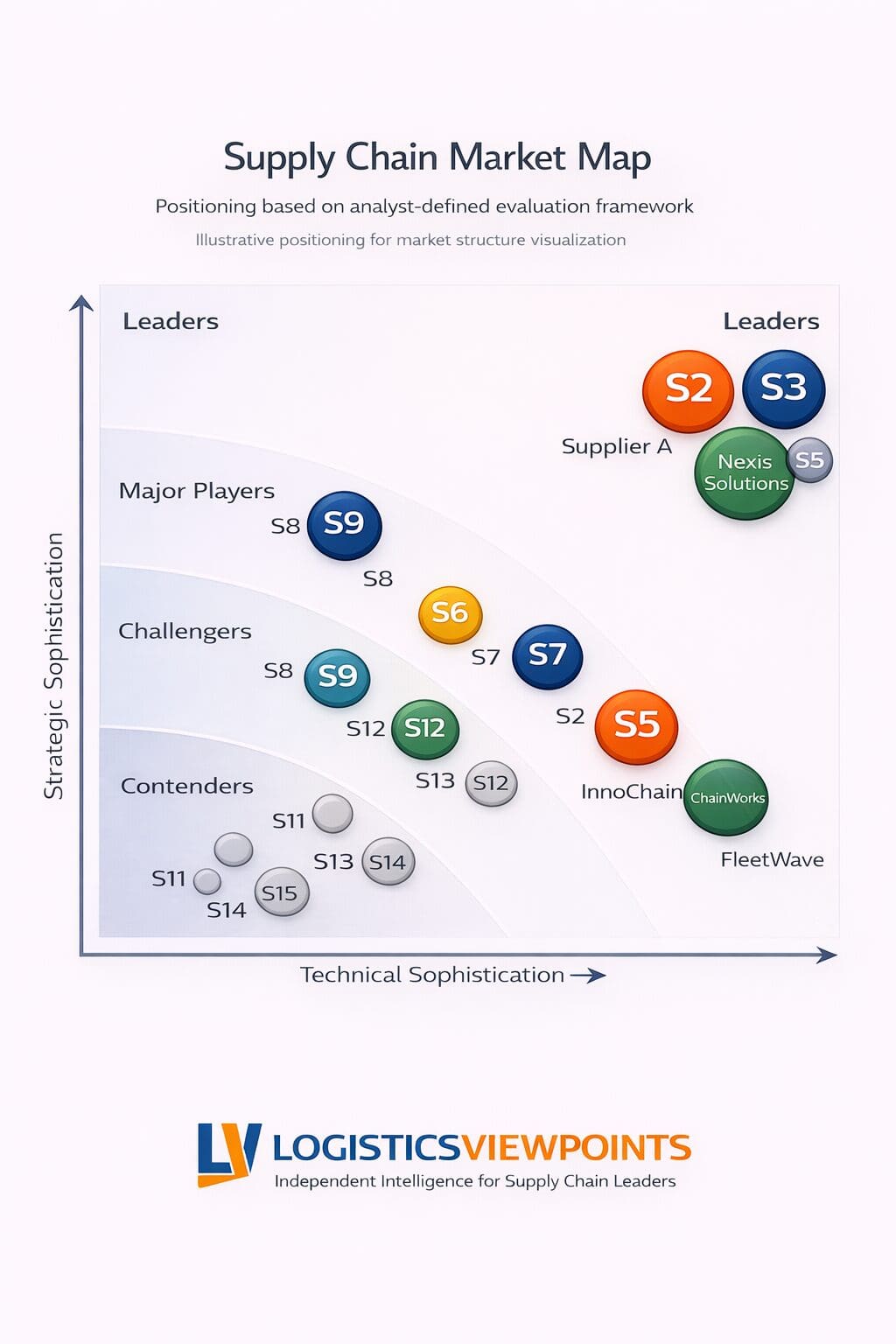
The frontline worker, the warehouse manager, the supply chain executive – they’re all staring into a fog bank when trying to choose the right technology. It’s not just about functionality anymore; it’s about disentangling a marketplace where every vendor claims to offer the silver bullet, even if they’re using entirely different ammunition.
And this is precisely why Logistics Viewpoints’ new Market Maps initiative matters. Forget the vendor jargon for a moment. What we’re seeing is an attempt to impose order on chaos, to draw a clear diagram of a territory that’s been rapidly overgrown with competing claims and overlapping functionalities.
Why Does This Matter for Real People?
For the folks on the ground making purchasing decisions, it’s about saving time, money, and a whole lot of headaches. When categories like Warehouse Execution Systems (WES) and Warehouse Management Systems (WMS) start to look like identical twins with different birth certificates, even seasoned professionals can get lost. These Market Maps promise a structured way to educate themselves, to shortlist potential providers based on a consistent analytical framework, and importantly, to get everyone in their own organization on the same page before a single RFP is sent out.
But it’s not just for the buyers. Suppliers stand to gain too. Imagine a clearer understanding of where your own product fits, how you truly differentiate, and whether your go-to-market strategy is hitting the mark in a crowded field. That’s the promise here – a more objective external view of positioning and fit.
“Supply chain technology decisions are too important to be shaped only by vendor claims. They need structure, context, and disciplined comparison.”
That quote, straight from the Market Maps’ own description, hits the nail squarely on the head. For too long, the narrative has been dictated by marketing budgets and sales pitches. This is an effort to inject a dose of analytical rigor into what has become an opaque and often bewildering ecosystem.
Is AI’s Supply Chain Impact Truly Being Clarified?
ARC Advisory Group is also chiming in, releasing a white paper on how AI is pushing beyond simple assistant roles to shape actual operational decision-making. They’re talking about A2A coordination, multi-enterprise orchestration, and the use of retrieval architectures and graph-enhanced reasoning. It’s a signal that the AI conversation in supply chain is moving from theoretical musings to practical, integrated execution systems. This isn’t about a chatbot suggesting an order; it’s about AI embedded deep within the core operational logic of supply chains.
The question remains, however: will these Market Maps truly cut through the noise, or will they become just another layer of analyst-speak that vendors can learn to game? The devil, as always, will be in the execution. The promise of a defined market scope, a visual provider landscape, and a curated provider set is substantial. But the proof will be in how effectively these maps stand up to the relentless churn of product development and vendor repositioning.
There’s a historical parallel here, perhaps. Think of how financial markets evolved. Initially, information was fragmented and opaque. The rise of standardized reporting, analyst ratings, and clear valuation frameworks — while imperfect — brought a level of transparency that enabled better investment decisions. The supply chain tech market is arguably at a similar inflection point, desperately needing that kind of structured clarity.
What Are The Core Takeaways From This Market Shift?
Fundamentally, this move acknowledges a market reality: the supply chain technology landscape is no longer neatly compartmentalized. Vendors are increasingly offering solutions that span multiple traditional categories, creating confusion for buyers. The Market Maps approach, by defining clear analytical positioning models and providing visual landscapes, aims to offer a much-needed structured comparison tool. It’s an analyst-driven attempt to provide the kind of objective evaluation framework that’s been conspicuously absent, moving beyond vendor-specific narratives to offer a more holistic market perspective. For professionals tasked with selecting and implementing these critical systems, this structured approach could be a significant time-saver and risk-reducer.
🧬 Related Insights
- Read more: Container Shipping’s Suez Gambit: Overcapacity Looming?
- Read more: Israel’s Lebanon Pause Offer: Smoke Screen for Supply Chain Chaos?
Frequently Asked Questions
Will these Market Maps make technology selection easier?
Logistics Viewpoints aims for them to provide a clearer, more structured way to understand crowded markets, aiding category education, provider shortlisting, and internal alignment, thus simplifying the selection process.
Is AI truly moving beyond basic functions in supply chains?
Yes, according to ARC Advisory Group, AI is increasingly integrated into operational decision systems, moving beyond simple assistance to coordinate complex processes and enhance visibility and resilience.
How do these Market Maps benefit technology vendors?
They offer vendors a clearer external view of their positioning, differentiation, and go-to-market fit within their specific technology categories.