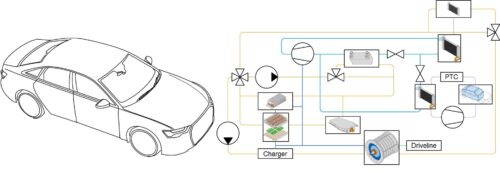
Look, the EV hype train has been chugging along for years, and every manufacturer worth their salt is promising a greener, faster, better future powered by batteries. And with that comes the inevitable avalanche of talk about ‘optimizing’ everything. This latest bit from Mathworks, wrapped up in a webinar about Battery Electric Vehicle thermal management systems, is no exception. We’re supposed to believe this fancy virtual model, built in Simulink and Simscape, is going to magically refine components and optimize systems for better vehicle consumption. Groundbreaking, right? (Spoiler: not really).
The pitch is this: they’ve built a virtual mid-size BEV with five key subsystems – electric powertrain, driveline, refrigerant cycle, coolant cycle, and passenger cabin. Then they’ll throw different drive cycles, cooling, and heating scenarios at it, analyze the results, and voilà! Determined the impact of design parameters on consumption. Sounds neat. It’s the digital equivalent of tinkering in the garage, but with more expensive software.
Who’s Actually Making Money Here?
That’s the eternal question, isn’t it? Mathworks, obviously, selling their Simulink and Simscape licenses. They’re the ones providing the tools, and they’re always keen to show off how their tools can be used to, you know, sell more cars. And the car manufacturers? Well, they hope this kind of simulation saves them millions in prototyping and real-world testing. If this virtual model can accurately predict how a battery will perform under extreme heat or cold, or how much energy is wasted managing its temperature, that’s valuable data. It’s about shaving off those precious percentage points of energy consumption, because in the EV world, every watt counts when you’re trying to convince consumers they can actually get to grandma’s house without needing a three-day charging break.
But let’s not get too carried away. This isn’t some kind of AI-driven miracle. This is advanced simulation, something engineers have been doing for decades in various forms. The difference is the increasing sophistication of the software and the ability to model incredibly complex interactions within a vehicle. Think of it as digital clay. You can mold it, test its stresses, and see how it behaves before you ever forge it into metal.
What this webinar is really selling is the promise of faster design iterations and reduced physical prototyping costs. The idea is to test a dizzying array of parameters virtually – different battery chemistries, cooling strategies, cabin heating loads – without building a fleet of expensive test vehicles. This saves time, saves money, and theoretically leads to a more refined product. And if the product is more refined, it means better range, quicker charging times, and happier customers. Or at least, happier spreadsheets for the accountants.
Is This Just More Tech Gloss?
Honestly, a lot of this feels like marketing fluff dressed up as innovation. The core concept – simulating vehicle performance – isn’t new. What is new is the increasing reliance on these digital twins and the ability to capture such granular detail about thermal dynamics. It’s easy to get lost in the jargon: ‘design exploration,’ ‘component refinement,’ ‘system-level optimization.’ It sounds impressive, but at its heart, it’s about making sure the car doesn’t overheat in Arizona or freeze solid in Anchorage, all while sipping electricity.
And let’s be clear, the results will be analyzed. That’s the point. They’ll crunch numbers to see how tweaking the coolant flow rate or the refrigerant pressure affects the overall energy drain. This kind of granular analysis is where the real value lies, assuming the model is any good. Because a bad simulation is worse than no simulation at all – it leads you down the wrong path, wasting time and money.
I’ve been around the block a few times, seen enough tech demos that promised the moon and delivered a slightly shinier rock. This BEV thermal management webinar falls into that category of ‘potentially useful, but let’s not get ahead of ourselves.’ It’s a tool, a sophisticated one, for engineers. It’s not going to magically solve the world’s energy crisis or put a flying car in every driveway. It’s about optimizing a specific, albeit important, aspect of electric vehicles. Who benefits most? The software vendors and the engineers who get to play with these fancy digital toys. The rest of us benefit indirectly, if the resulting cars are indeed better.
Virtual Vehicle Model: The core of this approach is a digital replica of a BEV, allowing for extensive testing without physical prototypes.
Simulink & Simscape: These are the specific software tools from Mathworks that enable the creation and manipulation of the virtual vehicle model.
Thermal Management: This refers to controlling the temperature of critical components like batteries, motors, and the passenger cabin to ensure optimal performance and longevity.
This whole exercise is a modern take on an old engineering problem. How do you make a complex machine work efficiently under a wide range of conditions? The answer, increasingly, involves a lot of very, very powerful computers crunching through virtual scenarios. Whether this particular webinar offers more than just a slick demo of Mathworks’ capabilities, well, that’s for the engineers who actually watch it to decide. My money’s still on the software company making a tidy profit.
