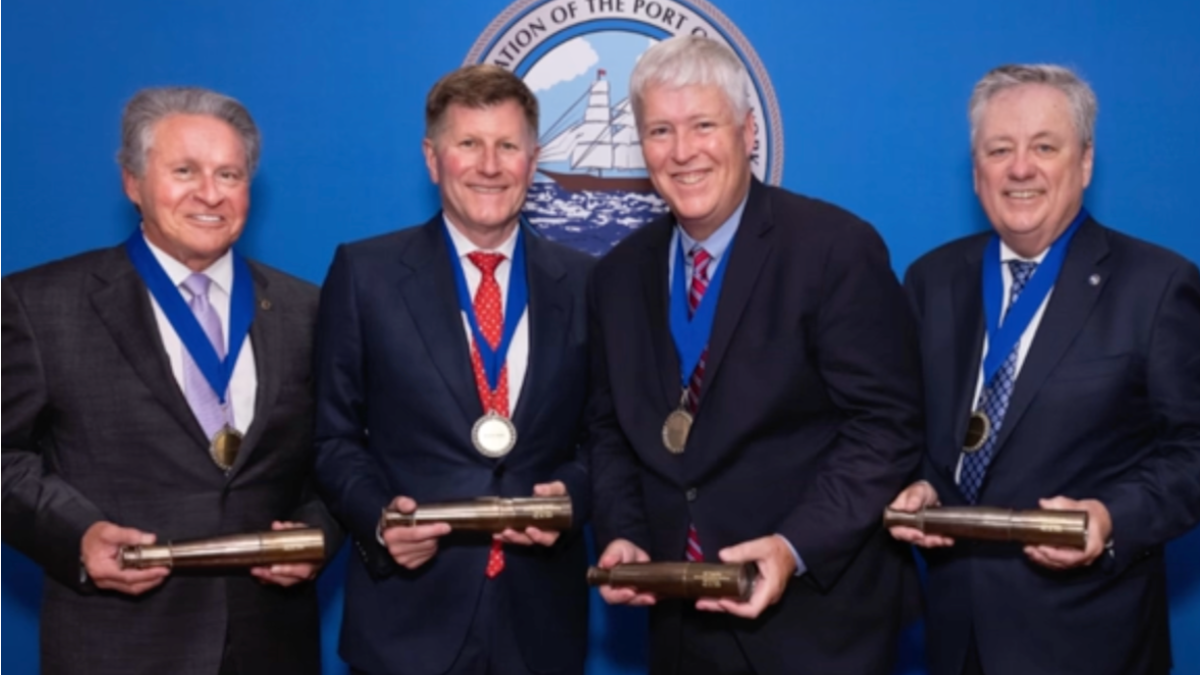
So, what does it mean when a guy who’s spent nearly half a century navigating the complex currents of a major labor union gets formally recognized by an industry hall of fame? It means that the unsung architects of our daily deliveries — the people who literally move the world’s goods — are finally getting their due. This isn’t just about one man’s career; it’s about acknowledging the foundational role of organized labor in the very fabric of global commerce, a role often overlooked in the shiny narratives of technological advancement. James W. McNamara, a name perhaps unfamiliar to the end consumer frantically tracking a package, is now enshrined alongside industry titans, and for good reason.
McNamara’s induction into the International Maritime Hall of Fame isn’t a surprise retirement party; it’s a proof to four and a half decades of unwavering commitment. He joined the International Longshoremen’s Association (ILA) during a period of seismic change, the era when containerization began its relentless march, transforming port operations from labor-intensive manual work into the highly mechanized, capital-intensive engines we see today. He didn’t just witness this shift; he helped steer the union through it, playing a significant part in forging the ILA into the powerful, unified entity it is now. Think about that for a second: the physical backbone of international trade, the docks, the cranes, the massive vessels — all fundamentally altered, and he was at the helm, ensuring his members were not just participants but beneficiaries of this revolution.
Beyond the day-to-day grind of negotiations and contract enforcement, McNamara’s impact rippled outward. His advocacy for longshore workers is a given, the core of his role. But the mention of “transformative charitable contributions” hints at a deeper engagement. We’re talking about a man who helped raise over $10 million for the ILA Children’s Fund. That’s not pocket change; that’s a profound commitment to the welfare of the maritime community, a recognition that the health of the industry extends beyond profit margins and into the lives of the people who make it run. It’s the kind of human element that gets lost in the quarterly reports and the talk of AI-driven optimization.
Why does this matter to us, the observers of the supply chain beat? Because it’s a stark reminder of the human capital at play. While headlines often scream about autonomous ships and blockchain-verified supply chains, it’s the steady, experienced leadership of figures like McNamara that has built the resilience and operational capacity we often take for granted. His long tenure mirrors the evolution of modern logistics. He saw the transition from break-bulk cargo to standardized containers, a shift that, while boosting efficiency, also demanded a new kind of worker and a new kind of union representation. His role was to ensure that progress didn’t leave people behind.
This induction also brings into sharp focus the collective power of organized labor in shaping industry standards. It’s easy to dismiss unions as relics of a bygone industrial age. But the ILA, and by extension McNamara, demonstrates their continued relevance. They are not just reacting to change; they are active participants in shaping it, ensuring that the advancements in technology and efficiency are met with corresponding advancements in worker well-being and industry stability. This is the real “how” and “why” behind the seemingly smooth flow of goods across oceans and continents: decades of strategic leadership, advocacy, and yes, even substantial charitable work.
The other inductees — Robert P. Burke, Capt. John W. Murray, and Ted Tregurtha — represent different facets of the maritime world, from shipping executives to port authorities. Their inclusion alongside McNamara paints a fuller picture of the ecosystem. Stephen Lyman’s quote highlights this interdependence: “These leaders have tirelessly championed progress, elevating the standards of our entire community.” It’s this sense of a shared community, built on years of shared challenges and successes, that such honors celebrate.
McNamara’s entry into this esteemed group is more than just personal recognition. It’s a symbolic acknowledgment of the vital, often invisible, workforce that underpins global trade. It’s a quiet nod to the fact that behind every container loaded and unloaded, every ship that docks, there’s a legacy of human effort, negotiation, and leadership that has made it all possible. And in a world increasingly obsessed with automation, remembering the human element—especially the power of dedicated collective action— feels more important than ever.
This isn’t just about historical reverence; it’s about understanding the ongoing human architecture of logistics. McNamara’s career spans the transition from a physically demanding, often dangerous, job to one that still requires immense skill and resilience, but within a modernized framework. His ability to navigate these shifts, to advocate effectively, and to contribute charitably, speaks to a leadership style that understands the multifaceted nature of a thriving port and a secure supply chain. It’s a leadership model that balances the raw mechanics of cargo movement with the human well-being that sustains it.
Here’s the thing: the supply chain is only as strong as the people within it. McNamara’s recognition is a powerful reminder of that enduring truth. It highlights the enduring influence of labor advocacy and the profound impact one individual can have over decades of dedicated service. The maritime industry, for all its technological marvels, still rests on the shoulders of those who work the docks, and figures like McNamara are the bedrock of that foundation.
The Human Element in the Age of Automation
While the industry buzzes with the promise of AI and automation, McNamara’s achievement serves as a crucial counterbalance. His 44 years of service highlight the human expertise and dedication that built the current infrastructure. This isn’t to say technology isn’t important, but it underscores that innovation rarely happens in a vacuum; it’s built upon the stability and foundational work established by long-serving individuals and organizations like the ILA.
A Legacy of Advocacy and Philanthropy
McNamara’s induction underscores the dual nature of his contributions: fierce advocacy for his members and a significant philanthropic footprint. Raising over $10 million for the ILA Children’s Fund demonstrates a commitment that extends far beyond the bargaining table, embedding a sense of community responsibility within the industry’s leadership.
What Does This Mean for the Future of Labor?
McNamara’s enduring presence and recognition in the Hall of Fame suggest that skilled, dedicated labor leadership remains a critical component of a stable and progressive maritime industry. In an era where automation is often presented as the sole path forward, this honor validates the ongoing importance of human negotiation, advocacy, and collective well-being in shaping the future of global trade.
🧬 Related Insights
- Read more: Ocean Freight vs Air Freight: Choosing the Right Shipping Mode
- Read more: Atlas Arteria: Who’s Really Knocking at the Door? [Multi-Billion Bid]
Frequently Asked Questions
What is the International Maritime Hall of Fame? The International Maritime Hall of Fame recognizes individuals who have made significant contributions to the maritime industry, celebrating their leadership, innovation, and impact.
How long has James W. McNamara been with the ILA? James W. McNamara has spent 44 years with the International Longshoremen’s Association (ILA).
What kind of impact did McNamara have beyond his union role? McNamara helped raise over $10 million for the ILA Children’s Fund, demonstrating a significant charitable contribution to the maritime community.