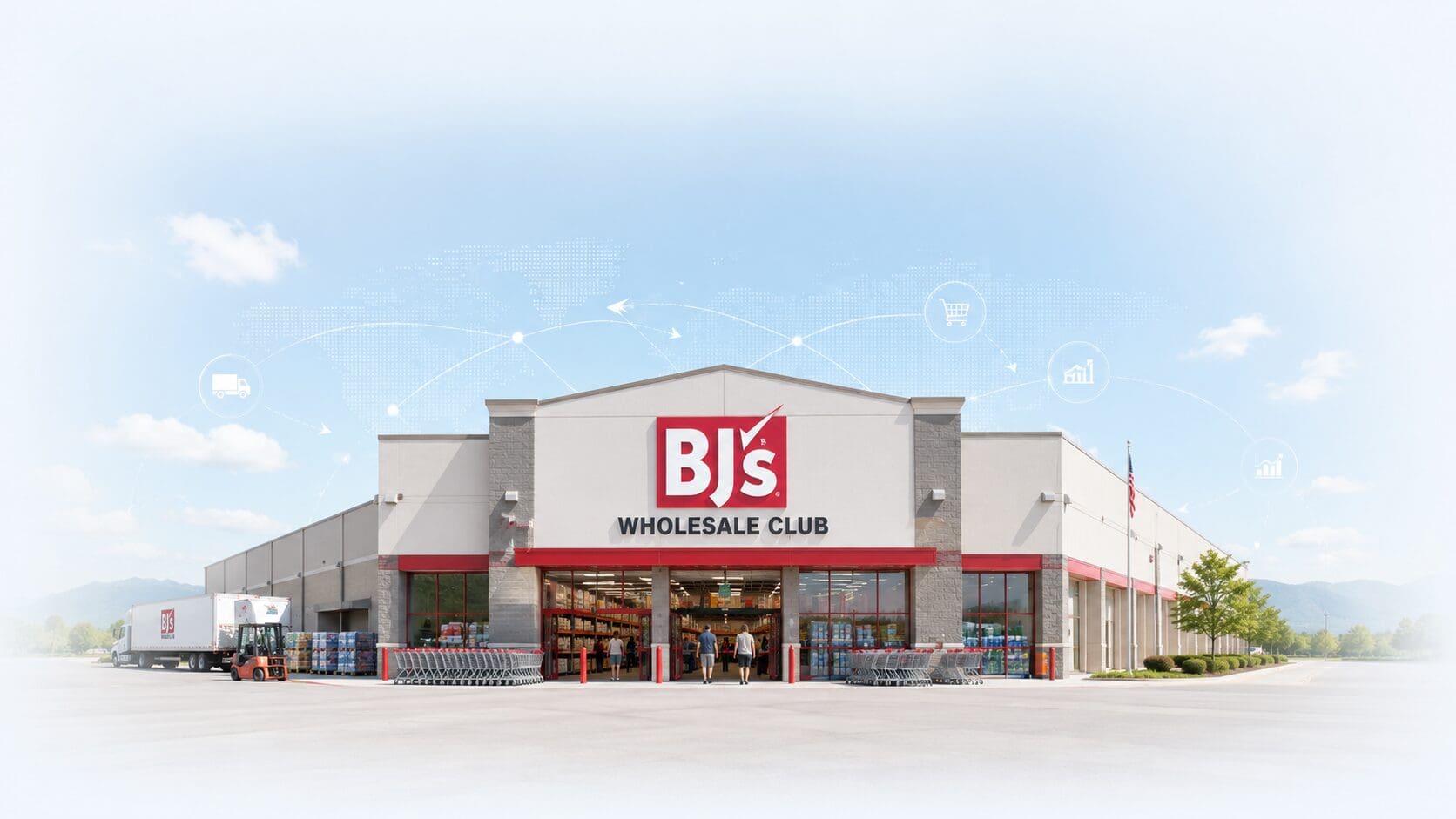
Supply chains are evolving. BJ’s proves it.
Remember 2020? Logistics Viewpoints patted BJ’s Wholesale Club on the back. “Underappreciated supply chain story,” they chirped. The magic? “Operational discipline.” Direct purchasing, cross-docking, minimal SKUs, truckload buying, rapid inventory turns. No-frills store execution. Simple, effective, and frankly, a bit boring. But it worked.
Six years later, that operational backbone still stands. But the BJ’s narrative? It’s gotten a lot more interesting. The question now isn’t if warehouse clubs can outperform fancier retail models. It’s whether BJ’s can keep its lean, mean supply chain humming while adding digital convenience, wrestling with fresh food’s inherent complexities, and planting flags in new territories.
This is precisely why BJ’s is a case study worth dissecting. It’s not just another Costco clone or a Sam’s Club also-ran. It’s a regional powerhouse attempting to stretch its disciplined supply chain DNA across higher-frequency grocery runs, digital fulfillment headaches, the volatile gas market, and uncharted geographic waters.
The Old Guard: Supply Chain as a Weapon
The classic warehouse club playbook is built on fundamental supply chain advantages. Forget the glitter of supermarkets and supercenters. Clubs hoard fewer items. They buy in bulk. Pack sizes are king-size. Handling is minimized at every step. The result? Serious purchasing power. Truckload efficiencies. Velocity in inventory. Less staff required to just move stuff around. BJ’s has always understood this.
Their strategy? Buy direct. Ship direct. Bypass unnecessary steps. Distribution centers act as high-speed transfer points, not long-term storage facilities. Goods arrive from manufacturers and are dispatched to clubs with minimal delay. This model smashes dwell times, slashes inventory holding costs, and sidesteps the labor drain common in traditional warehousing. It’s not just about cheap goods; it’s about a smarter, leaner flow of goods. That’s how they compete on price.
The Plot Twist: What’s New Since ‘20?
Since that last glowing review, a few things have amplified. First, the membership model. It’s more than just a revenue stream; it’s the engine. High renewal rates translate to predictable income. That predictable income fuels everything: aggressive pricing, expansion, digital investments, and yes, more supply chain upgrades.
Second, digital is no longer an afterthought. BJ’s isn’t just asking members to wander aisles with carts. They’re pushing curbside pickup, same-day delivery, app-based ordering, and digital engagement. This fundamentally alters the operational demands on their club network. Inventory accuracy becomes paramount. Labor scheduling? A high-wire act. Order staging and fulfillment discipline? Non-negotiable.
Third, the map is being redrawn. BJ’s is heading into Texas. The Forney location is a big bet. It’s a test: can this model thrive outside its established eastern U.S. comfort zone? The company touts Forney as its 264th club and 202nd gas station, with more Texas locations planned. This expansion shifts the strategic conversation. In 2020, we asked how BJ’s created savings. Now, the $64,000 question is: can they preserve those savings while entering new markets and juggling digital fulfillment complexities?
Regional Clout Still Pays Dividends
BJ’s isn’t aiming to blanket the country. It’s a regional player. That’s a crucial distinction. Costco and Sam’s Club have national footprints. BJ’s strategy seems to be about building density within specific regions. From a supply chain viewpoint, this is pure genius. Concentration is key. Distribution, transport, real estate, labor, marketing—all benefit when they’re focused. A lone club in a distant market is a logistical nightmare. A cluster of clubs? That’s where the efficiencies multiply. Better replenishment, stronger brand recall, smarter use of distribution assets.
The Texas gambit will be telling. Dallas-Fort Worth offers population growth, suburban sprawl, new households, and a car-centric culture. All good signs for a warehouse club. But Texas is also a battleground. BJ’s must prove its value proposition isn’t merely regional and that its supply chain can handle these new clusters without collapsing under the weight of added complexity. This isn’t just about opening doors; it’s about making sure the back rooms and loading docks can keep up.
Grocery Frequency: The Real Challenge
Here’s the part many miss: BJ’s focus on grocery frequency. Warehouse clubs are often seen as occasional big-buy destinations. BJ’s, however, is pushing for more regular visits. That means stocking fresh produce, meats, and dairy. It means shorter shelf lives. It means managing temperature-sensitive products. It means dealing with spoilage.
This brings a whole new set of supply chain requirements. Traditional warehouse club models prioritize long shelf life and minimal handling. Grocery, especially fresh, demands speed, cold chain integrity, and tighter inventory control. It’s the difference between storing lumber and storing milk. BJ’s has to ensure its distribution centers and its clubs can handle the increased throughput and the specialized handling needed for perishables. It adds strain to the system, especially in a new market.
Is This Just Corporate Spin?
BJ’s is trying to thread a needle. They want the efficiency of their old model, the reach of digital, and the growth of new markets, all while managing the headaches of fresh groceries. Is it possible? Absolutely. But it requires more than just ambition. It demands relentless execution.
“The company’s advantage was not e-commerce glamour. It was operational discipline: direct purchasing, cross-docking, limited SKU complexity, truckload buying, fast inventory turns, and no-frills store execution.”
This quote from the original piece still rings true. The danger lies in diluting that discipline. Adding complexity is easy; maintaining efficiency while doing so is the hard part. Companies often fall in love with the idea of being digitally advanced or geographically vast, forgetting that their core operational strengths are what truly matter. BJ’s has a solid foundation. The next few years will tell if they can build upon it without compromising its integrity.
It’s easy for a company to talk about evolving supply chains. It’s much harder for them to actually do it, especially when juggling multiple, sometimes conflicting, demands. BJ’s isn’t just expanding its store count; it’s expanding its supply chain’s responsibilities. This isn’t a minor tweak; it’s a fundamental evolution of their operational DNA.
🧬 Related Insights
- Read more: Lazaro Cardenas Hub Ambitions Stymied by Customs Chaos
- Read more: Zebra Ditches Robots: Skild AI Gets Fetch [Analysis]
Frequently Asked Questions
What is BJ’s Wholesale Club’s main competitive advantage? BJ’s historically use operational discipline, including direct purchasing, cross-docking, limited SKUs, truckload buying, and fast inventory turns, to compete on value.
How is BJ’s adapting its supply chain for digital orders? BJ’s is integrating curbside pickup, same-day delivery, and app-based ordering, which requires enhanced inventory accuracy, labor planning, and order staging within its club network.
Will BJ’s expansion into Texas succeed? Texas presents an opportunity due to population density and shopping patterns, but BJ’s must prove its supply chain can support new regional clusters efficiently and compete in a crowded market.